
The MonteZOOMa project should’ve been an easy one. This wasn’t some massive new roller coaster stretching across half of Knott’s Berry Farm. It wasn’t a record-breaking giga coaster with thousands of feet of track, a dozen near-misses and an entirely new themed land built around it. Montezooma’s Revenge was only 800 feet long, and the entire ride lasted about 36 seconds.
Yet, as of July 2026, the coaster has been closed for more than four years. It missed its original 2023 reopening, then it missed a newly announced 2025 reopening. Its famous flywheel launch was removed, its original train was removed and its loop was literally cut apart. The surrounding Fiesta Village renovation opened without it, Cedar Fair merged with Six Flags while it was still under construction, and fans spent years trying to figure out whether the project was delayed, redesigned or just quietly canceled.
Now, finally, trains are launching again. Knott’s has been testing MonteZOOMa: The Forbidden Fortress with water dummies and eventually human riders. A media preview is reportedly scheduled for July 20, 2026, with a public opening expected shortly after, although Knott’s hasn’t announced an exact public opening date as of writing this.
So yeah, it appears this whole thing is finally reaching the finishing line. But how did we get here? How did one of the shortest roller coasters in America become one of the longest and strangest refurbishment projects the theme park industry has ever seen? Once I really started digging into it, the answer became a lot more complicated than I expected.
Quick note about the title: Knott’s originally called this a “major renovation,” so the park never claimed it was just repainting the ride and calling it a day. “Simple renovation” refers more to how manageable this project initially seemed from the outside, especially for such a short coaster. Also, February 2022 to July 2026 is roughly four years and five months. The project touched five calendar years, which is where “five-year” comes from. So there ya go.
A Short Little Coaster That Made History
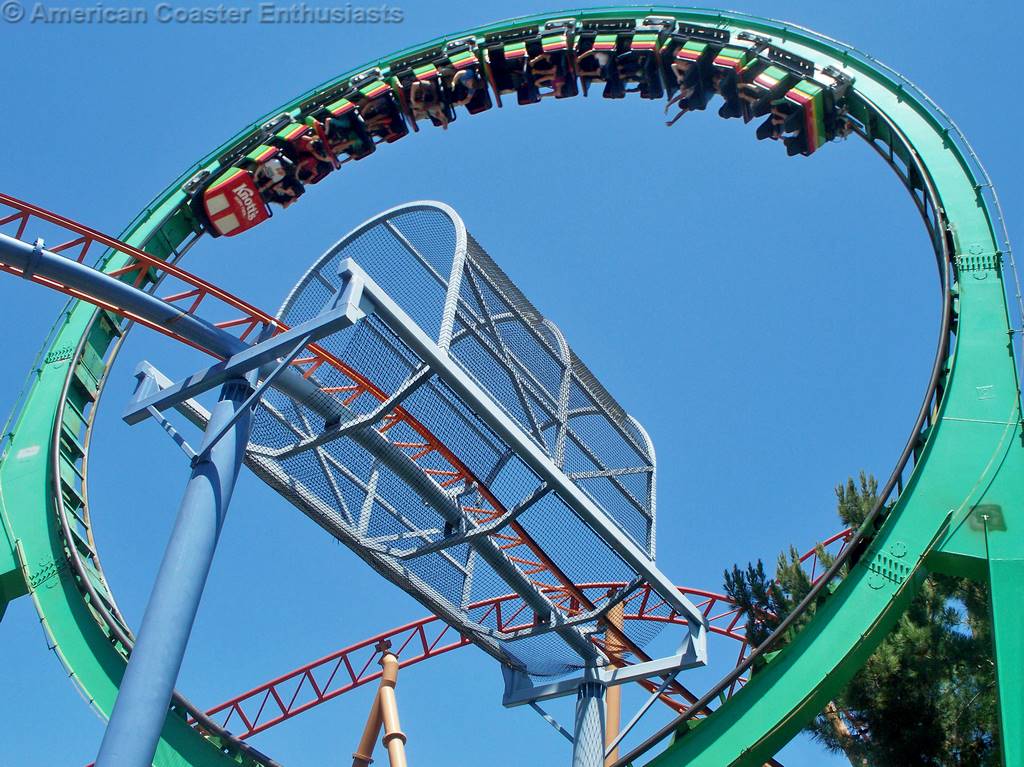
Before getting into everything that went wrong, we need to establish why Montezooma mattered in the first place. The ride opened at Knott’s Berry Farm in May 1978, although the exact date is weirdly difficult to pin down. Knott’s has celebrated May 21 as its birthday, American Coaster Enthusiasts lists May 25, and a newspaper published on May 26, 1978 said it opened at noon that day. That probably comes down to preview events vs. the official public opening, but I couldn’t find a record that completely clears that up. The safest answer is simply that it opened during the final week of May 1978.
What isn’t disputed is how unusual the coaster was. Built by German manufacturer Schwarzkopf, Montezooma was one of the earliest shuttle-loop roller coasters. Rather than climbing a lift hill and completing one large circuit, the train launched straight out of the station, traveled through a vertical loop, climbed a tall spike, rolled backward through the loop and station, climbed another spike behind the station, and finally settled back where it started. The whole thing was over in about half a minute, but it packed a lot into the runtime.
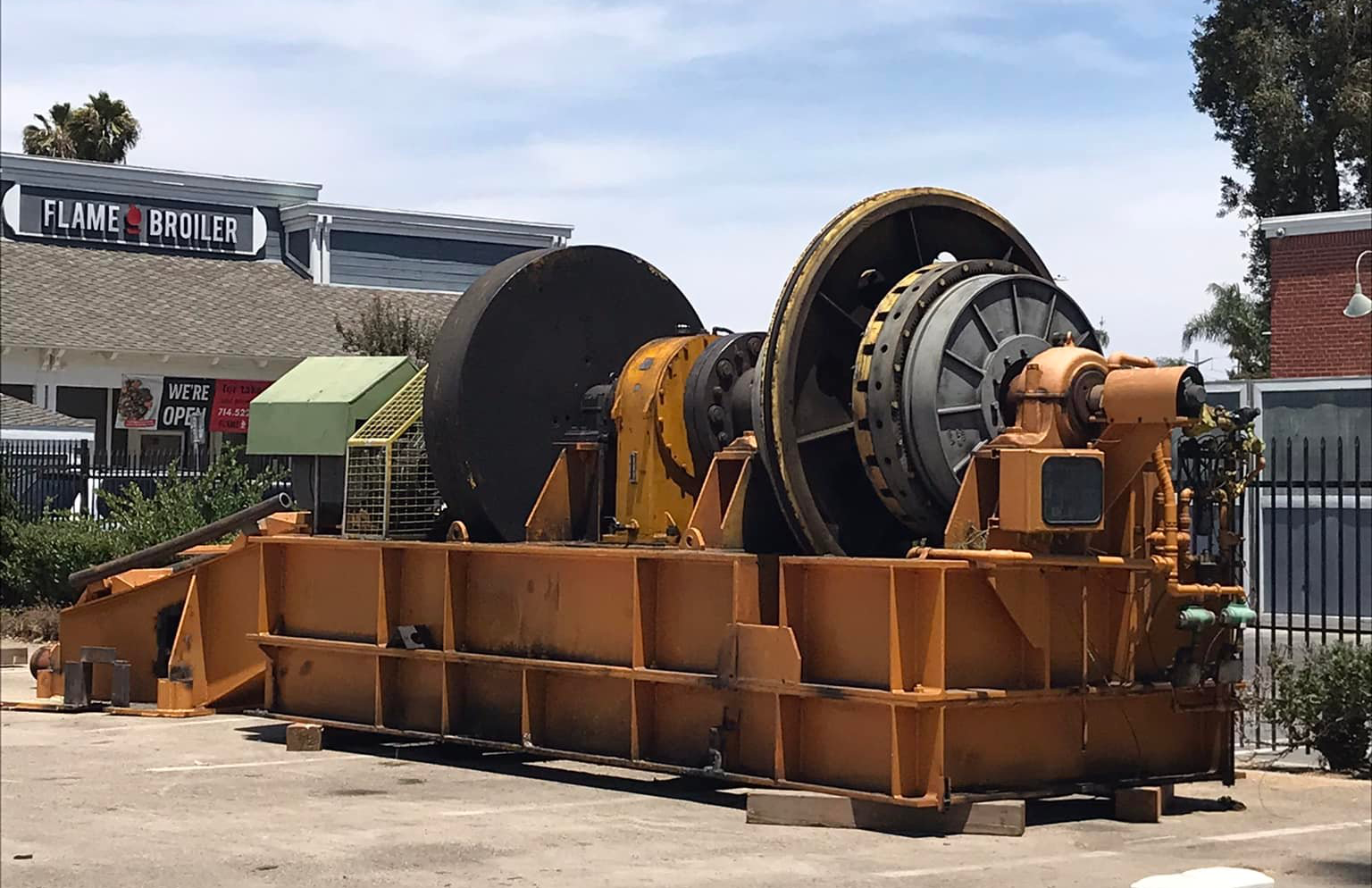
The most important part was its flywheel launch. A giant spinning wheel stored energy, then a clutch transferred that energy to a cable and a small catch car beneath the train. That system pulled the train from 0 to roughly 55 miles per hour in 4.5 seconds. Basically, imagine a giant mechanical slingshot hidden beneath the station. It was loud, forceful and very old-school.
Montezooma was the first flywheel-launched roller coaster in the world. As other Schwarzkopf shuttle loops closed or were modified, it eventually became the last operating example in the United States. It was also the oldest shuttle loop still standing in its original location, which earned it an ACE Roller Coaster Landmark designation in 2019.
I actually rode Montezooma during my visit to Knott’s all the way back in 2017. In my extremely old Limitless Park trip report, I described it as not quite an all-star attraction like GhostRider or Xcelerator, but praised its launch and the weightlessness on the backwards spike. That still feels about right. It wasn’t the biggest coaster at Knott’s, but it was one of the most distinctive. You could find taller and faster rides all over California, but you couldn’t find another Montezooma.
Knott’s Announces a 2023 Renovation
On January 7, 2022, Knott’s announced that Montezooma’s Revenge would close three days later for what it called “major renovations.” The park promised “exciting changes” while preserving the ride’s “unique charm,” with the new version scheduled to open in 2023. That gave fans almost no time to say goodbye, and the response was strong enough that Knott’s changed course. On January 11, the park announced that Montezooma was “back by popular demand” for a limited period.
It was a nice gesture, especially since nobody realized just how final those last days would feel. On February 1, Knott’s announced that the coaster would officially close on February 7. That became its final public operating day. Some databases list February 8 because that was the first full day the ride was unavailable, but February 7 was the actual goodbye.
At this point, Knott’s hadn’t announced exactly what it was doing. The park didn’t name a manufacturer, announce a budget or explain which parts would be preserved or replaced. It didn’t even give a detailed reason for why such a large renovation was needed. There were some pretty obvious possible benefits though. A modern launch and braking system could potentially be easier to maintain than a 44-year-old flywheel, clutch and cable. New controls could improve the reliability, and new parts would be easier to source than parts for a coaster manufacturer that no longer existed in its original form. Those explanations make sense, but they’re still just informed guesses. Knott’s never publicly said, “We are doing this because the flywheel became too unreliable,” or gave us a detailed engineering diagnosis. All guests knew was that an upgraded Montezooma was coming in 2023. At the time, there wasn’t much reason to doubt it.
Then Knott’s Cut the Loop Apart
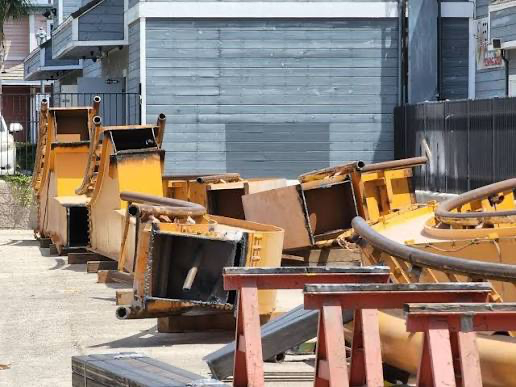
If this were a normal refurbishment, most of the original coaster would’ve remained standing while crews worked on its machinery, controls and station. But that’s not what happened. Over the next several months, construction followers documented the removal of the train, flywheel hardware and sections of the track. By July 2022, the coaster’s famous vertical loop had been cut into pieces and removed.
That was the point of no return. Knott’s could still rebuild a coaster with the same layout, but the original Montezooma was no longer sitting there waiting to be turned back on. Major pieces of the historical ride were physically gone.
Some of them were at least preserved. Knott’s and Cedar Fair donated two original ride vehicles, the entrance sign and part of the loop to the National Roller Coaster Museum and Archives. Later coverage from Amusement Today showed that the donation included the lead car, the last car with its clutch plate, loop track and the old sign. That’s awesome from a preservation standpoint, as it means future generations will be able to see real pieces of one of the most important launch coasters ever built.
Of course, it also confirmed that those pieces were not coming back. The final location of the original flywheel remains unclear. I couldn’t find any official announcement saying whether it was preserved, stored, scrapped or sent somewhere else. This created a pretty fascinating preservation question. Montezooma had been declared a historical landmark only three years earlier, and now its original launch, train and loop were all being removed. How much could Knott’s replace before this stopped being the same historical coaster? It’s a real “Ship of Theseus” question.
MonteZOOMa: The Forbidden Fortress
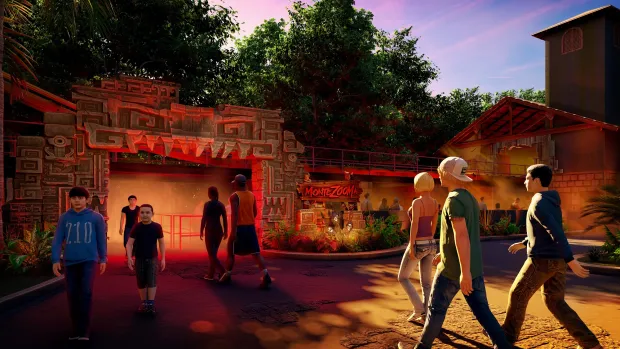
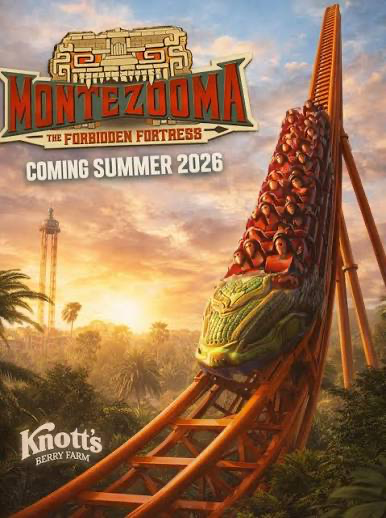
On August 11, 2022, Knott’s finally revealed the complete concept. The refurbished coaster would be renamed “MonteZOOMa: The Forbidden Fortress” as part of a much larger refresh of Fiesta Village. And the capital letters in “ZOOM” were added because theme park marketing departments can never resist a pun, apparently.
The ride’s new story involved treasure hunters entering a mysterious fortress in search of Montezooma’s gold. The queue would include booby traps and remains of people who had tried and failed to steal the treasure before you. Family fun! Anyways, the biggest ride change was a randomized launch sequence, meaning guests would supposedly not know which direction the train would launch first.
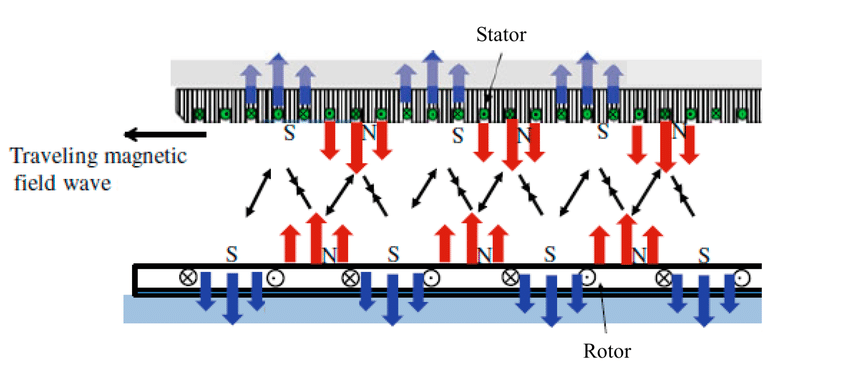
Instead of the original flywheel, the coaster would use a modern magnetic launch. The basic idea behind a linear synchronous motor, or LSM, is fairly simple. Rows of electromagnets along the track interact with magnets on the train, pulling or pushing it forward without a cable physically dragging it.
LSMs are now common on launched roller coasters, but installing them on a ride from 1978 isn’t super easy. The new train had a different weight, the launch forces had to work in both directions, and the brakes and control system needed to know exactly where the train was at all times, while the retained track and supports had to connect with replacement pieces. All the while everything had to still fit inside a cramped section of Fiesta Village surrounded by buildings and the track for the neighboring coaster “Jaguar!”
That doesn’t explain why the project eventually took so long, but it does explain why the words “only 800 feet of track” can be misleading. This was now a modern ride system being worked into a very old and unusually tight layout.
Knott’s advertised the coaster and refreshed Fiesta Village for summer 2023. The park even promoted 2023 season passes as a way to experience it. There was no uncertainty in the marketing. MonteZOOMa was coming in 2023…until it wasn’t.
Fiesta Village Opens Without Its Star Attraction
On May 9, 2023, Knott’s finally acknowledged what construction watchers already suspected. “Due to construction delays,” the park said, MonteZOOMa wouldn’t open with Fiesta Village that summer. No replacement opening date was announced, and Theme Park Insider preserved the full statement for people to read.
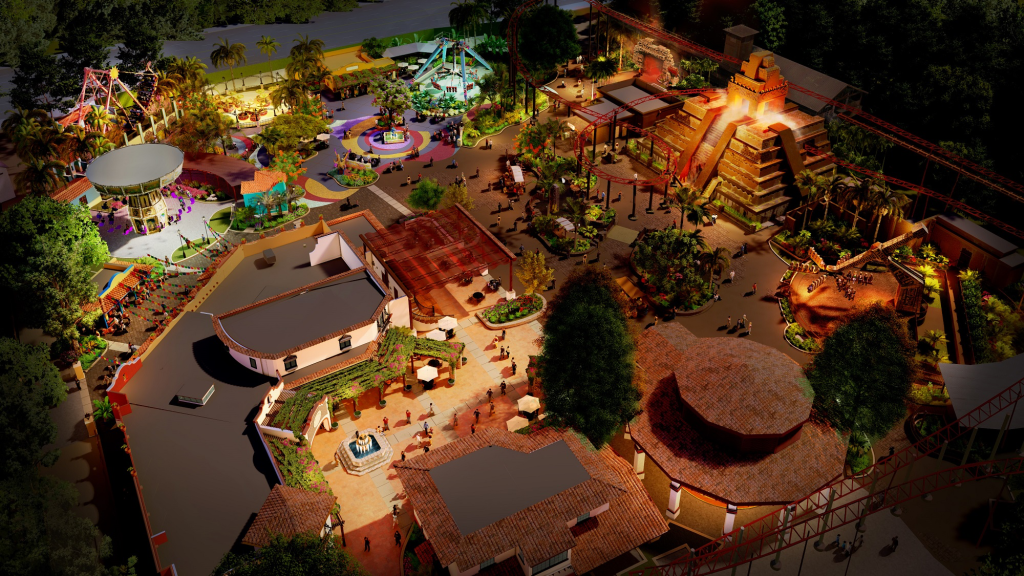
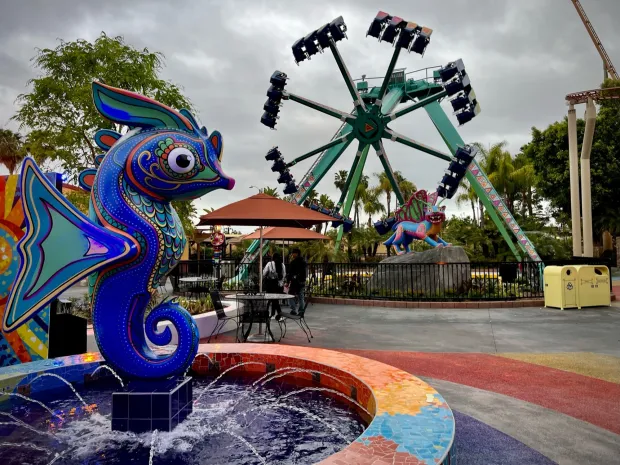
That was technically an explanation, but not a very satisfying one. What kind of construction delays? Had a manufacturer fallen behind? Did the new launch system have engineering problems? Were permits taking longer than expected? Had Knott’s changed the design? The park didn’t say. Fiesta Village reopened on May 26, 2023. The land received updated restaurants, refreshed rides, new colors and improved entertainment. By most accounts, the renovation looked pretty nice. But its signature coaster remained closed in the middle of it.
That made MonteZOOMa’s absence so much harder to ignore. If the entire land had just stayed behind construction walls, the coaster would’ve just been one unfinished piece of a larger project. Instead, guests could walk through the finished Fiesta Village and look directly at the attraction that was supposed to be headlining it.
Then almost nothing happened publicly for the rest of 2023. There might have been some design work, contract negotiations or off-site manufacturing behind the scenes. A lack of visible construction doesn’t prove that everybody had simply gone home. Still, from a guest’s perspective, the project looked absolutely dead. This is where the MonteZOOMa story started turning into an investigation conducted almost entirely by theme park fans. People watched the site from Jaguar!, examined aerial images, followed construction vehicles and tried to identify contractors from logos on their clothing. Every minuscule thing became a clue, while everything that wasn’t there became a crisis.
Some fans claimed the project had run into lead-paint problems. Others said the manufacturer had failed to deliver. There were rumors about lawsuits, canceled contracts and entirely different replacement coasters. I haven’t found enough documentation to confirm any of those claims though. Some could eventually turn out to be true, but right now they belong in the rumor category, not the factual timeline.
The Mysterious “Terminated Project”
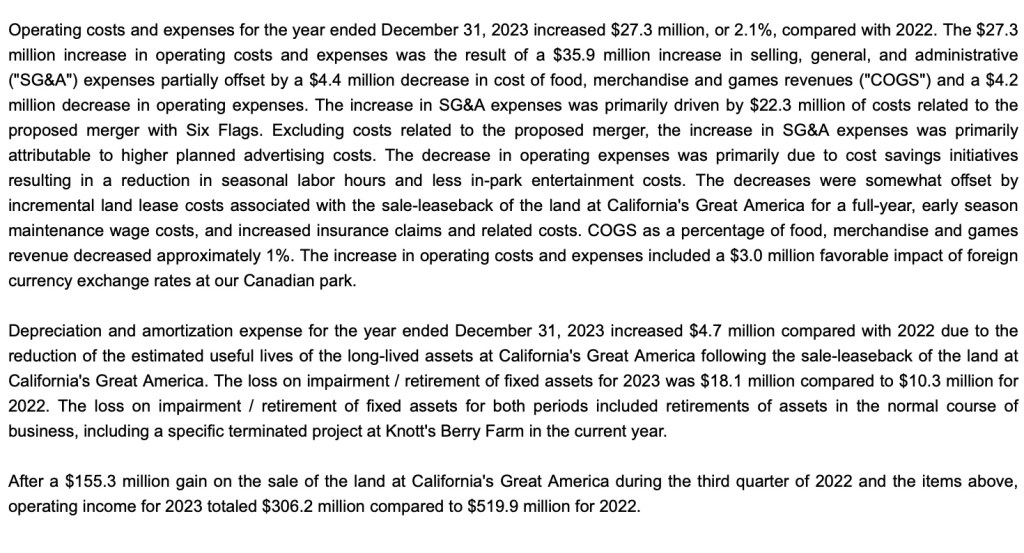
In February 2024, MonteZOOMa disappeared from the Knott’s mobile app. That didn’t prove anything by itself, since a ride that couldn’t open wasn’t really useful info in a list of operating attractions. Combined with the lack of progress, though, it felt ominous. Then fans found something much more interesting. Cedar Fair’s annual financial filing for 2023 reported $18.1 million in company-wide losses from the impairment or retirement of fixed assets. That total included money related to a “specific terminated project at Knott’s Berry Farm.”
MonteZOOMa was the obvious suspect. It was a major Knott’s project, it had missed its opening, construction appeared stalled and pieces of the original ride were already gone. You’d think that would be cased closed, but not quite. The filing never named MonteZOOMa, and it also doesn’t say that the entire $18.1 million came from the unnamed Knott’s project. That number covered impairment and retirement losses across the whole company.
It’s possible that Cedar Fair terminated an earlier version, contract or collection of assets connected to MonteZOOMa, wrote off that work and later restarted with a new plan. That would fit the available timeline surprisingly well. It’s also possible that the filing referred to another Knott’s project. Without an internal document or somebody willing to confirm it on the record, we can’t absolutely turn the connection into a fact. That’s probably the single most repeated claim about the project that still remains unproven. “Cedar Fair wrote off $18.1 million on MonteZOOMa” makes for a great headline. But the actual filing doesn’t say that.
Work Resumes (Re-ZOOMs)
Two weeks after the financial filing renewed fears that the coaster was dead, Knott’s broke its silence. On March 1, 2024, the park posted that work was “re-zooming” and announced that MonteZOOMa would open in 2025.
So that was good news. The attraction hadn’t been completely canceled. But it also raised a few questions. What exactly was resuming? Had the design changed? Was Knott’s working with a new manufacturing? What happened to the 2023 version? Why would a coaster that had already been under construction for two years need another full year? Once again, the park did not explain. Fans were relieved, but the mood had changed. The original 2023 date had sounded dependable. The new 2025 date felt more like something everybody would believe after seeing track installed. And before that could happen, the entire company changed around the project
What Six Flags Actually Inherited
Cedar Fair and Six Flags announced plans to merge in November 2023. The deal officially closed on July 1, 2024, creating a combined company called Six Flags Entertainment Corporation. That makes it tempting to describe MonteZOOMa as a Cedar Fair disaster that the new Six Flags inherited and eventually fixed, but the corporate details are messier.
Legacy Cedar Fair investors received approximately 51.2% of the combined company, while legacy Six Flags shareholders received 48.8%. Cedar Fair CEO Richard Zimmerman became the leader of the merged company, and later filings even identified Cedar Fair as the accounting acquirer and corporate predecessor. In other words, the company was named Six Flags, but this wasn’t the old Six Flags marching into Buena Park and taking the project away from Cedar Fair. There was a lot of Cedar Fair continuity inside of the new company.
The merger still mattered though. The combined Six Flags inherited responsibility for finishing the coaster, funding whatever remained and explaining the delays to guests. It also gave the project a useful before-and-after point. The original concept and first failure belonged to Cedar Fair, while the final reconstruction and opening happened under Six Flags. But did the merger directly rescue MonteZOOMa? Did new executives approve more money, change suppliers or demand a new schedule? We don’t know. Visible work increased after the merger, but timing alone doesn’t prove causation. The restart could’ve been planned before the deal closed. Until somebody involved explains what changed, the most honest conclusion is that Six Flags inherited the responsibility, not necessarily a completely new project.
MonteZOOMa Finally Starts Looking Like a Roller Coaster Again
For most of 2024, the project still didn’t look anywhere close to opening. That finally changed in 2025. In May, track began arriving at Knott’s Berry Farm. Park officials told the Orange County Register that this was existing track that had been cleaned and recoated locally. That detail matters because another simplified version of this story says Knott’s threw away the entire original coaster and built a new one. That’s not accurate either. The original loop was definitely cut apart and replaced, and the train and flywheel were removed. At the same time, at least some existing track was cleaned and returned. Exactly how much original track remains is still unclear though. Knott’s hasn’t released a track-piece inventory, and trying to calculate a precise percentage from construction photos would be silly. We can say the final coaster is a mixture of retained and replacement pieces. We just can’t map out every bit of it yet.
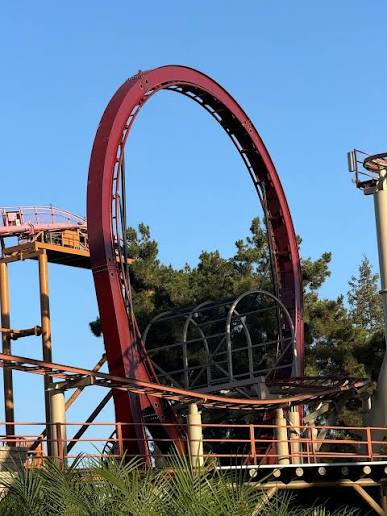
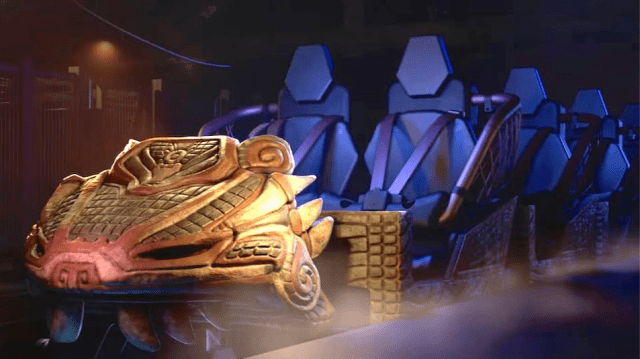
The first returning track sections were installed in June 2025. Within days, a new maroon-colored loop rose over Fiesta Village. After years of looking like a demolition site, MonteZOOMa looked like Montezooma again. Around this time, people wearing Kumbak-branded clothing were photographed working near the coaster. Kumbak is a Dutch ride company formed by former Vekoma employees, and the new train that appeared also looks consistent with Kumbak equipment. That’s some strong evidence that Kumbak worked on the final version.
Knott’s still hasn’t publicly released a detailed supplier list. We don’t know whether Kumbak provided the train, integrated the entire ride system, inherited part of another company’s work or handled some combination of those jobs. We also don’t know who fabricated every replacement track section, supplied the LSMs or programmed the final control system. Those distinctions might sound overly technical (and they kinda are), but they matter when people try to blame one company for the whole delay. The available evidence shows Kumbak at the project, but that doesn’t tell us that Kumbak caused every problem dating back to 2022.
And Then 2025 Passed
Despite the visible progress, MonteZOOMa didn’t open in 2025. The second announced opening year came and went, and I could not find a major Knott’s announcement explaining why. There was no detailed breakdown of a new engineering issue or a dramatic post saying the ride had officially moved to 2026. The target simply changed in later park and corporate materials. That makes the delay harder to measure than it first appears. We can confidently say the project missed two announced opening years: 2023 and 2025. We can’t confidently count every internal delay because Knott’s never made its internal milestones public.
Maybe the park privately expected the train in one month and received it three months later. Maybe the control system failed an acceptance test. Maybe plans were revised several times before construction resumed. Those would all represent additional delays, but there is not enough public evidence to place them on the timeline.
By the beginning of 2026, at least the finish line was becoming visible. On February 2, Six Flags included MonteZOOMa in its official capital announcement as “NEW in 2026.” This time, construction began backing up the marketing.
The Long Road Through Testing
The final visible gap in the track was installed in March 2026, and LSM fins appeared along the launch. In April, Knott’s officials said the ride was expected to open by summer 2026 or sooner. Then the coaster started moving through a recognizable testing process. First came a pull-through vehicle. This is basically a slow clearance check. Engineers move a frame representing the train’s outer limits around the track to make sure nothing enters the space riders or vehicles will occupy. The actual train appeared in May.
Fan reaction was mixed, to put it kindly. The original train had a wonderfully open design, while the new train appeared to use a much bulkier over-the-shoulder restraint arrangement. Before anybody had even ridden it, people were already worried about comfort, headbanging and the loss of that classic Schwarzkopf feeling. Online comments are not scientific polling, but the reaction showed that people were not simply waiting for any roller coaster to open. They wanted Montezooma back.
Slow powered movement began in early June. By June 15, the train was performing short launch tests, and a few days later it traveled through the loop. During one short-shot test, the train lost momentum and stopped between the loop and spike. It had valleyed. That sounds terrible if you’re not familiar with coaster testing. In this case, it does not appear to have been a major failure. Engineers intentionally start with weaker launches and gradually adjust the system. A shuttle coaster also needs a recovery plan for any situation where the train stops away from the station, so crews used a winch to pull it out. There’s no public evidence that the valley caused another meaningful delay. Testing continued with water-filled dummies, which simulate the weight of riders. The train began completing more of the full cycle. Then, on July 7, videos showed human test riders aboard. That was probably the biggest sign yet that this thing was real. After two missed opening years, a removed loop, years of rumors and enough construction updates to fill an entire YouTube channel, people were finally riding MonteZOOMa again. They just weren’t regular guests yet.
As of July 12, Knott’s still lists the coaster as “Relaunching in 2026.” Multiple outlets report that the park has invited media to preview it on July 20. Public opening information is expected around that event, but July 20 itself should not be treated as the confirmed public opening date. After everything that has happened, I’m not going to say this is finished until guests are actually walking through the entrance. We’ve seen stranger things happen with stuff in recent memory with stuff like Top Thrill 2.
Is It Still the Same Roller Coaster?
This might be the most interesting question surrounding the entire project. The rebuilt attraction occupies the same location, follows the same basic shuttle-loop layout and retains at least some original track and supports. It continues the history of a coaster that opened in 1978. But it also has a new launch system, new train, new restraints, new loop, new control system, new theme, redesigned queue and a slightly new naming scheme. So what exactly is this thing?
From a park and historical-lineage perspective, it’s still Montezooma. Knott’s didn’t demolish the attraction and announce an unrelated replacement. The entire project has been marketed as a transformation of the existing coaster. From a mechanical and experiential perspective though, a lot of the original ride is gone. The flywheel wasn’t just another replaceable part, it was what made Montezooma historically significant. The original train and lap-bar experience shaped how the launch and spikes felt, while the original loop was one of the most visible pieces of the landmark. Like I said earlier, this thing is basically the roller coaster version of the Ship of Theseus. If you gradually replace the parts of a historical machine, when does it become a different machine? There’s not really a clean, clear answer. The new MonteZOOMa can be a genuine continuation of the original coaster while also being a fundamentally different ride experience. Saving the layout and location is better than losing it completely, but that doesn’t mean every historical concern disappears once the ride opens.
The final judgment will depend on what the ride actually delivers. Does the new launch feel forceful? Does the train travel smoothly? Are the restraints comfortable? Does the promised randomized launch sequence actually operate? Did Knott’s build the fortress effects and story it advertised in 2022? Those are questions only the finished attraction can answer.
What We Know, What We Think, and What We Still Don’t Know
After going through years of announcements, filings, construction footage and fan reports, the most honest summary looks like this:
Confirmed
- Knott’s closed Montezooma in February 2022 for major renovations and initially promised a 2023 return.
- The original flywheel, train and loop were removed.
- The project became MonteZOOMa: The Forbidden Fortress with a new story and planned randomized launch.
- Construction delays caused it to miss the Fiesta Village reopening.
- Knott’s later announced a 2025 opening, which it also missed.
- Some original track was cleaned and reinstalled, while other track was replaced.
- The coaster now uses an LSM launch and replacement train.
- The combined Six Flags company carried the project through final construction and testing.
- Human testing began by July 2026.
Strongly indicated, but not fully documented
- The project went through at least one substantial redesign after its original announcement.
- Kumbak worked on the final ride system or train.
- The long delay involved more than ordinary on-site construction scheduling.
Still Unconfirmed
- The exact reason the original 2023 plan failed.
- Whether the unnamed terminated Knott’s project in Cedar Fair’s filing was connected to MonteZOOMa.
- The number of times the ride was redesigned.
- The exact responsibility of each manufacturer and contractor.
- The total cost, including work that may have been abandoned.
- How much original track remains.
- Whether the Cedar Fair-Six Flags merger directly changed the project.
- Whether the final launch sequence is genuinely randomized.
That missing info is definitely frustrating, but guessing the answers doesn’t really make this article more complete, it just makes it less accurate. So that’s why I thought I’d lay that out.
What Theme Parks Should Learn From MonteZOOMa
MonteZOOMa is an unusually extreme example, but it reflects a larger problem with modern theme park projects. Parks want to announce attractions early. They need something exciting to sell season passes, generate news coverage and convince guests to plan future trips. A firm opening year looks much better in an advertisement than “whenever the engineers finish figuring this out.”
Engineering doesn’t really care about the marketing calendar. Knott’s announced MonteZOOMa for 2023 before the final technical path was publicly proven. After that date failed, the park announced 2025. When that date failed too, there was barely an explanation. The delays themselves were bad, but the communication was what made it worse. Silence didn’t stop people from talking about MonteZOOMa, it just handed the story to rumors. Fans filled the information vacuum with app listings, tarps, contractor logos, financial filings and blurry photos taken from nearby rides. Knott’s didn’t need to reveal confidential contracts or publish engineering blueprints, just give us occasional factual updates that could separate real problems from speculation.
The project also shows how difficult historical preservation becomes when a ride needs modern technology. Keeping a 1978 coaster alive forever with its original machinery might’ve not been super realistic. Parts age, manufacturers go defunct, and safety requirements and operating expectations change. At some point, replacing major systems is the only alternative to permanent removal. But that doesn’t make every replacement automatically good. Parks need to decide which parts create the attraction’s identity and communicate what guests are actually losing. For Montezooma, the historical mechanism was the experience. Replacing it was always going to crate a debate, even if the new system works perfectly.
The project is also a warning about attaching a delayed attraction to a larger land renovation. Fiesta Village successfully reopened in 2023, but MonteZOOMa sat right in the middle of Knott’s, visibly changing year after year while the park said almost nothing. Guests watched the historical ride disappear, then slowly watched a new version grow in its place.
The Wait Is Almost Over…
MonteZOOMa’s journey is wonderfully ironic when you think about it. The coaster launches out of its station, races through a loop, climbs a dead-end spike, reverses direction, passes through the same track again and finally returns to where it started. The renovation did basically the same exact thing. It launched with a confident 2023 promise, raced into demolition, reached a dead end, reversed through a redesign, passed into a newly merged company and eventually found its way back to Fiesta Village. The only difference is that the ride completes its journey in 36 seconds. The project needed more than four years.
If MonteZOOMa opens after its July 20 media preview and operates reliably, its return should still be celebrated. Knott’s could’ve decided the entire mess was no longer worth finishing, but instead, one of the most historically important coaster layouts in America will survive in some form. That’s definitely a victory. However, it’s also impossible to look at two missed opening years, removed historical hardware, unexplained redesigns and years of corporate silence and call the project a success from beginning to end. The new ride might be great. I genuinely hope it is, as that would make the wait feel a little better for the park and a lot better for everyone who has spent years staring at an empty loop. But it won’t erase how strange the journey to completion was. Montezooma’s Revenge was known for sending riders backward before bringing them home. Apparently, the refurbishment needed to do that too.
For Further Reading…
American Coaster Enthusiasts Roller Coaster Landmark record
Schwarzkopf Shuttle Loop technical archive
Knott’s original January 2022 renovation announcement
Knott’s 2022 Forbidden Fortress announcement reproduced by Westcoaster
National Roller Coaster Museum donation announcement
Cedar Fair-Six Flags merger closing announcement
 Limitless Park